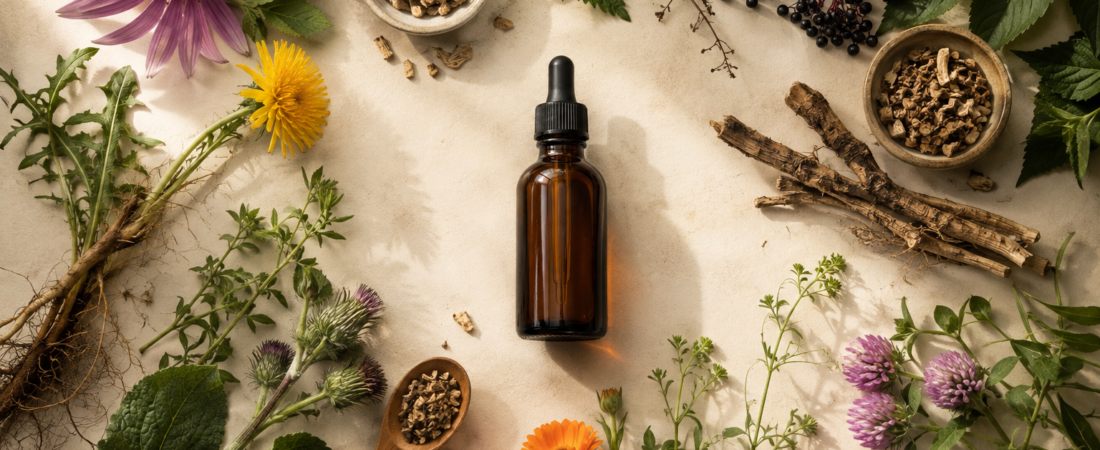
BuzzLab’s liquid formula brings together individually listed botanical extracts and a broader proprietary blend in one 2 mL serving. Rather than treating a long ingredient list as a promise of a particular outcome, this guide explains how the formula is organized, what the label tells you, and how to approach botanical supplements thoughtfully.
This article is educational and does not replace medical advice. Individual experiences vary.
The formula at a glance
- Format: liquid dietary supplement with a measured dropper
- Serving size: 2 mL
- Servings per container: 30
- Formula structure: eight individually declared botanical extracts plus a proprietary botanical blend
- Other ingredients: glycerin, water, citric acid, and natural flavors, according to the current label
Eight botanicals listed with individual amounts
The Supplement Facts panel declares the following extracts separately. Amounts below are per 2 mL serving and should always be verified against the label on your product.
Echinacea purpurea extract — 100 mg
The label identifies aerial parts and a 10:1 extract. Echinacea has a long history of use in traditional botanical preparations. Here, our focus is ingredient identity and formulation—not a promise to prevent or treat illness.
Dandelion extract — 90 mg
Dandelion is listed as a whole-plant 10:1 extract. Different products may use leaf, root, or whole plant, so reading the plant part is an important part of comparing labels.
Burdock root extract — 110 mg
Burdock is specifically identified as a root extract. Roots have traditionally been used in botanical food and wellness preparations, but historical use should not be confused with proof of a medical outcome.
Cleavers extract — 80 mg
Cleavers (Galium aparine) is identified by its botanical name and aerial parts. Botanical names help distinguish a plant from similarly named ingredients.
Calendula extract — 90 mg
Calendula is widely recognized for its distinctive golden flowers. The current label lists a 10:1 extract.
Red clover extract — 50 mg
Red clover is identified as a flower extract. Consumers who take medications or manage hormone-sensitive conditions should discuss botanical supplement use with a qualified healthcare professional.
Nettle leaf extract — 60 mg
Nettle is listed specifically as a leaf extract. This is a useful example of why the plant part matters: leaf and root products should not be assumed to be equivalent.
European elderberry extract — 50 mg
European elderberry is identified as a fruit extract. The ingredient appears alongside, not inside, the proprietary blend.
What is inside the proprietary blend?
The label lists a 95 mg Lymphatic Drainage Proprietary Blend. Its components include prickly ash bark extract, bromelain from pineapple, astragalus root extract, turmeric root extract, rutin, rosehip extract, lemon peel powder, plantain extract, yarrow leaf/flower, thyme leaf extract, kelp extract, fucoxanthin-rich seaweed, Ceanothus americanus extract, and blue vervain extract.
The 95 mg represents the total blend weight per serving—not 95 mg of every ingredient. Under FDA labeling rules, proprietary blend components are named but their individual quantities are generally not disclosed.
Why liquid format?
A liquid can be convenient for customers who prefer a measured dropper instead of capsules or tablets. Format is a matter of preference and routine; it does not automatically make a supplement stronger, faster, or more effective.
A more responsible way to think about “22-in-1”
The phrase describes the breadth of botanical ingredients represented across the formula. More ingredients do not necessarily mean a better product for every person. A thoughtful choice also considers serving size, ingredient form, other ingredients, warnings, medications, allergies, and personal needs.
How to use the formula thoughtfully
- Read the complete label before first use.
- Measure only the serving stated on the product directions.
- Keep a simple record of the supplements and medicines you use.
- Do not combine multiple botanical products without checking for overlapping ingredients.
- Ask a healthcare professional or pharmacist about possible interactions.
Our formulation philosophy
BuzzLab is rooted in the idea that botanical wellness should feel understandable and easy to integrate into modern life. We aim to present the formula clearly, avoid guaranteed outcome language, and encourage customers to combine any supplement with balanced nutrition, hydration, movement, sleep, and appropriate medical care.
View the complete BuzzLab formula page →
Learn from trusted sources
- NIH: Botanical Dietary Supplements
- FDA: Questions and Answers on Dietary Supplements
- How to Read a Botanical Supplement Facts Label
* These statements have not been evaluated by the Food and Drug Administration. This product is not intended to diagnose, treat, cure, or prevent any disease.